

In late November, I was getting some FOMO from seeing posts of handspinners sharing lovely fibre advents and breed study advents. Budget constraints being a powerful catalyst, the idea of putting together my own Fleece Study Advent, all from quantities of fleece I’d already accumulated, came to me at midnight on the 29th. By 2am on the 30th November, I was ready to go.

I had thirteen different fleece samples, of ten different breeds (including crosses), to process and spin up, the first half of which I opened one by one as a surprise every other day. When I got to the remaining six, however, I went rogue (in true Mia fashion) and opened all of them at the same time, working with them in an order that was conducive to comparing breeds or different fleeces of the same breed.
But first, glamour shots of the complete advent. Note: All of these skeins have been spun on supported spindle, using a supported long draw, from hand-combed top.


Highlights and lowlights—lightning round
Breeds included: Bond (2), Bond cross (1), Border Leicester (1), Corriedale (2), Corriedale cross (1), Cheviot cross (1), Finn (1), Merino (3), Polwarth (1), Black Faced Suffolk (1).
Total amount of spun yarn: 1022m/215g. White fleece: 379m; coloured fleece: 643m. All are anywhere from 16-22 WPI.
Highest grist: superfine Merino (light grey), at 630m/100g or 3134 YPP. This was Day 1, which makes sense as I was too used to spinning my default yarn.
Lowest grist: Black Faced Suffolk (white), at 345m/100g or 1710 YPP. This down wool is so hefty, it was hard for me to spin it fine.
Median grist: 450-520m/100g or 2230-2577 YPP.


Favourite to spin on spindle: “Silver” the Border Leicester, “Shazza” the Corriedale, and the Bond×Merino.
Least favourite to spin on spindle: all the superfine Merino, and anything with a staple length longer than 12cm.
Favourite finished yarn: “Shazza” the Corriedale, “Marilyn” the Corriedale cross, “Silver” the Border Leicester, “Dairymilk” the Polwarth, and all the Bond.
Least favourite yarn: maybe all the superfine Merino—I find the lack of toothiness bothersome.
Mistakes were made~
I don’t know how well you can see it, but in the photo below, there are so many tiny bits of VMs and dirt scattered throughout this combed top. I had been careless and hadn’t picked out the dirty tips in this merino. Because of how fine and grabby the fibres are, combing only broke the VMs into smaller bits that got stuck in the wool. The resulting yarn was, erm, not my best work.

A couple days before that, I had also felted parts of the Bond×Merino skein. I was working on it right on the heel of the Suffolk skein (a down breed that resists felting), so I was very cavalier and dunked it in hot-cold water five times (should have stopped at three). Re-skeining it afterwards was not an experience I’d like to relive any time soon.
All the samples, all the steps
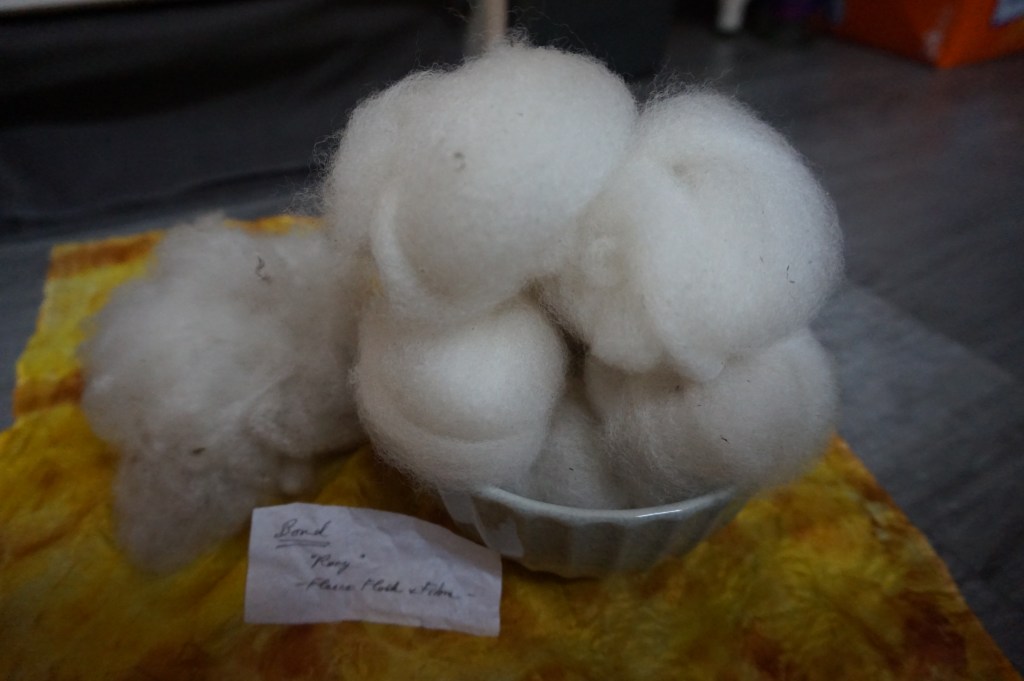
All these samples started as 25-28g of scoured wool. I came up with the—if I may say—very clever idea of photographing the fleece in the same bowl for each sample, so you can see how bulky or condensed each breed appears compared to one another.
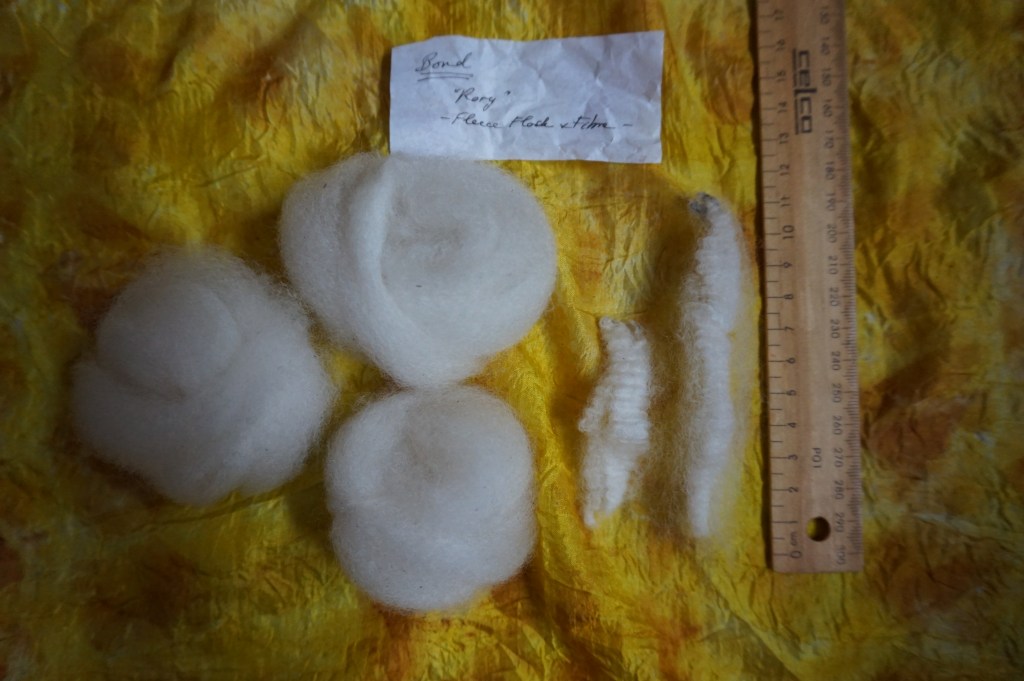
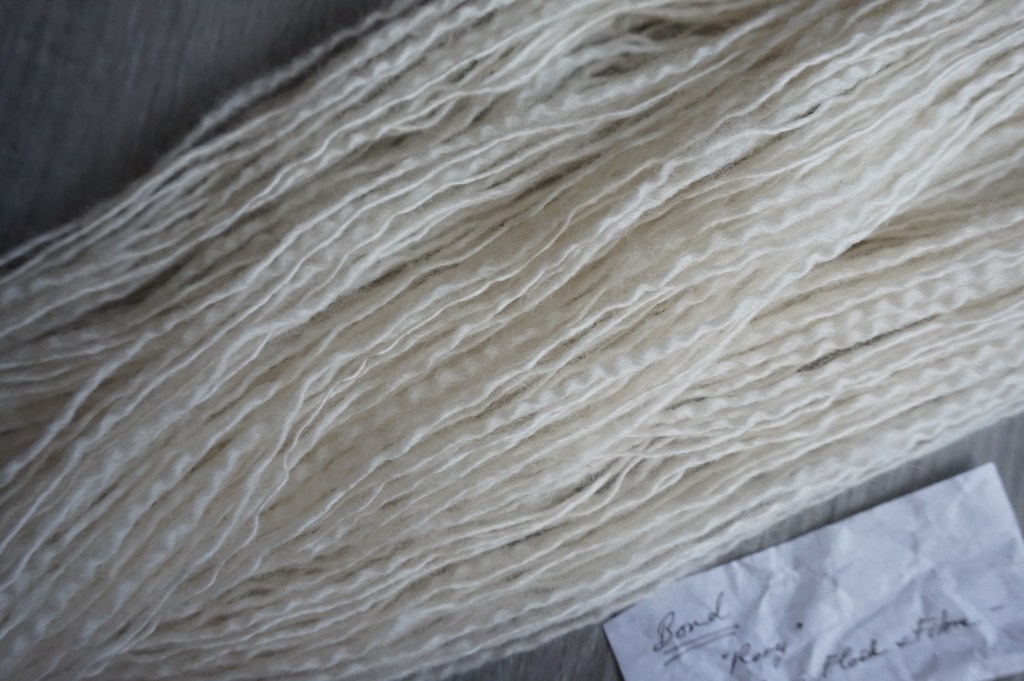
Bond, “Rory”, Fleece Flock and Fibres, NSW. This was one of the skeins that I snapped and thwacked before fulling, and the thwacking probably reactivated some of the crimp pattern which then is locked in by the fulling. You can see some wavy sections in the finished hank:


Bond, “Little Brown Teapot”, Tiny Lola Bond Yarn, VIC. I was so intrigued by the hint of russet in this fleece. It was a joy to spin—7-10cm staple length seems to be my sweet spot for support spindling:


Bond×Merino, Kan-B Colours, VIC. This colour has my heart. It looks as if there’s a hint of pink or gold, depending on the light. The fine halo on the spun yarn is so lovely:


Border Leicester, “Silver”, Silver Cedar Wool, NSW. This is the softest Border Leicester I’ve ever had my hands on. It’s next to skin soft, with a silvery sheen.


Corriedale, “Shazza”, Fleece Flock and Fibres, NSW. This was the spin that made me fall in love with spinning white fleece. There is a very pleasant toothiness to this fibre that makes spinning it engaging:


Corriedale cross, “Marilyn”, Kandos High School, NSW. It’s a beautiful yarn, but the 13+cm staple length made it a bit challenging to spin supported. I had to remind myself constantly to hold the fibre source further from the point of twist to be able to draft out:


Cheviot×Corriedale, “Wally”, Pleasant View Fibres, NSW. I suspect this crossbreed leans more Cheviot, as there is a bulkiness and harshness (not unpleasant, though) that is not at all Corriedale-like:


Finn lamb, Fairfield Finns, VIC. This fleece put up a fight. So many tiny bits of VMs were embedded throughout the locks, the tips needed to be pinched off, and combing yield was 49%. But the end result is so lofty and soft and pleasing to look at:


Merino (white), NSW. I think this staple length probably lends itself better to carding:


Merino superfine, “FLC71”, The Shepherds Choice, NSW. My fingers got quite bored spinning this superfine fleece. There is a disconcerting lack of any tactile feeling that is just not my cuppa, even though any yarn from this and the other Merinos I’ve sample would be extremely next-to-skin soft:


Merino superfine, “FLC73”, The Shepherds Choice, NSW:


Polwarth, “Dairymilk”, Wyndara Black Sheep, VIC. Similar to “Marilyn” the Corriedale, the staple length is so long that support spinning it was a little awkward. There is some banding in the fleece (it doesn’t affect the structure, just the colouring) that diffuses in the prep and final yarn, adding a hint of lighter colour here and there:


Black Faced Suffolk, The Shepherds Choice, NSW. This one made me understand why people say down breeds are good for sock yarn; I had to do five cycles of hot-cold with agitation to even full it a bit:


My method for processing, spinning, and finishing to achieve a strong and stable soft-spun singles
I wanted the focus of this project to be on the breed (and individual fleece) characteristics, so I did not spin with a desired grist in mind. All thirteen samples got essentially the same treatment: hand combed1 and dizzed off into top, spun on supported spindles using a supported long draw, then fulled lightly during wet finishing2.
For this type of spinning, prep is 90% of the game. Every single spin where I took my time with the combing and dizzing turned out much more satisfactory than the ones where I rushed through processing!
Combing and dizzing off
With the fineness level of the combs I have, I found that the medium wools only needed two passes, while the super fine wools like the Merino I used required up to four passes to fully open up.
I used the 2mm hole on my diz to diz off combed tops, then wound them loosely into small nests. When spinning, I broke the nests into forearm’s lengths, then spun them at random to evenly distribute any colour variation.


Spinning
I used an assortment of supported spindles, weighing anywhere between 25-35 grams. After this whole exercise, I can now comfortably spin anywhere from laceweight to heavy fingering weight singles, with low twist, on these spindles.
On supported spindles, the biggest difference between spinning singles to ply versus to remain as singles yarn, to me, comes down to how hard my spindle hand flicks the spindle for each make and how far ahead of the point of twist my fibre hand moves.
- My habitual supported spinning method is to flick the spindle hard (similar to the speed of a snapping motion, if that makes sense) to build up lots of twist energy at once, and immediately my fibre hand drafts back fast while the spindle hand pinches/releases the single near the spindle tip to release that initially created twist energy in small rapid bursts, just enough for my fibre hand to draft against. This is how I get a very fine, high-twist single.
- Meanwhile, to get a softer, low-twist single (the plyback of which won’t qualify as usable yarn), my spindle hand gives the spindle a firm flick, instead of the usual snap-flick. Still with my spindle hand acting as a floodgate for the twist energy, my fibre hand drafts back just a tad faster than for a single intended for plying—just that little bit ahead of the point of twist—and I stop adding twist the moment I feel that “bite” of twist lock.
I noticed quickly, too, that the length of my makes for soft singles was shorter than that for singles-to-ply. I reckon this is because, as there is only once chance to establish consistency of the yarn instead of being able to reply on plying averaging out any inconsistent sections, I wanted to observe every inch of singles drafted out. Naturally, it’s easier to keep the working area just within my line of sight, so I very consciously kept myself from pulling out too long a length from the spindle tip.


Knowing that there is no plying to disguise inconsistencies, I became quite ruthless at discarding the last lumpy bits of fibre in a length of top and breaking off any accidental thin bits.


Finishing (with light fulling)
Since the singles was spun from combed top, I wanted to retain some level of smoothness, in terms of the direction in which the fibres were originally drafted.
I wound off the singles using a ball winder, so that the outer end of the cake is the first spun end, then wind it onto the niddy-noddy, smoothing the yarn with my fingers all the way through.
To keep easy count of the number of rounds, I added a “counting tie” i.e. a string that I twisted around groups of 20 strands on the niddy-noddy, as I went along.


I gave the yarn a 15-minute soak in the hottest tap water, used a salad spinner to spin out most of the water, then snapped and thwacked3 the hank to even out the twist and make the fibre pouf up a bit.


The next step, fulling, is where the structure of the singles yarn is really locked in.4 I filled two bowls with the hottest and coldest tap water, then *dunked the hank into the hot water, squeezed out, dunked it into the cold water, squeezed out*—repeating the * * dunking steps three to five times depending on the fibre’s proneness to felting. I stopped when the strands started to stick together a bit, as that signals the surface of the yarn is now very slightly felted, or “fulled”. At this level of fulling, the yarn is not hard or dense; it remains very soft and light.
Finally, I spun out the water, snapped the hank a couple more times, then hung it to dry–with a light S-hook on the bottom to even things out further.


Re-skeining and labelling
Usually, I don’t re-skein my handspun, since I’ve gone through the trouble of putting in the counting chain, plus my hanks mostly turn out quite neat and even.
However, for any yarn that has been fulled, I do re-skein all the yarn to unstick the strands so that later on, when I hand wind into balls, the hank will unravel smoothly.
The people with whom one shares fleece samples (and GIFs)
For a while now, my life has been full of uncertainties. The idea for this advent came mostly as a distraction for my racing thoughts, but the whole project became such a calming and purposeful aspect of my every day for the past three weeks. I was reminded of how community is just as large a part in this whole fibrecraft business as the crafting itself.
Even just on a purely practical level, sampling multiple breeds is so much more feasible when I can split full fleeces with friends. In Australia, raw fleece is usually sold by wool growers either as full fleeces (from one to even three kilograms would be the usual weight range in my limited experience) or by the kilos. Cost aside, one kilogram means a whole lot of fleece still to remain (taunting one from their stash) after sampling; a 200g bag is just a fun lil snack to try out something new with zero stress about storage space.
And then the same people with whom one shares fleece samples are most likely one’s brain trust, too. (I have lost count of how many out of all these samples were lovingly foisted upon me by my fibre friends.) Outside of the little group chat I have with my main fleece enablers, Azrah and Louise (do give them a follow, they make beautiful stuff), I have been learning so much from seasoned and prolific spinners like Melody of PacificCoasterFibers or my new friend Deirdre, a pillar of the Wollongong Spinners and Weavers group. Nuggets of scouring advice and breed knowledge even came to me from shepherdesses themselves, like Rani Smith, whose superfine merino fleeces are stunning, or Nevada Gotlands, one of whose fleeces I am earmarking for a special garment project. Every single person whom I’ve come to for advice has been nothing but kind and generous and excited to share their knowledge.
There is a camaraderie I feel every time I talk to a fibrecraft person, especially handspinners. We’re here making by hands things that are, really, not essential to a practical life, but nevertheless essential to tethering ourselves to a millennia-old tradition of textile and creativity, and to a world of tool makers, dyers, shepherdesses, shearers, and—well—sheep. There is the understanding that, no, we don’t need to be doing all this, but we do anyway, because it brings us such joy. So we go ahead and get our hands all greasy with lanolin, and we merrily bag up locks of wool for a friend or two.

1 the way I lash on to comb might well make some spinners faint. I don’t really keep track of tip- or butt-ends, but lash on so that whichever end that is more compacted is pierced by the tines. I find that this way, I can keep the number of passes to a minimum and reduce combing waste, while still getting a neat prep without any neps or VMs.)
2 For fulling, each skein got dunked into hot-cold water from three to five times, depending on how prone to felting the breed is.
3 Interesting enough, for skeins that were thwacked before fulling, the thwacking seems to have reactivated some of the crimp pattern, resulting in a slightly wavy/almost bouclé look in the finished yarn. This is most clear in the skeins of Polwarth and Bond.
4 I consulted this video by Rachel Smith and this blog post by Josefin Waltin, both on fulling soft-spun singles.


Leave a Reply