
This post is being typed very hastily at 10:30pm, but part of my goal for this blog is that I don’t pressure myself to only hit “publish” when a piece is perfect or to time posts for maximum engagement.
Consider this your bedtime reading, perhaps? I hope you, like me, enjoy going down fibrecraft rabbit holes before bed–my current main search term is “Ashford vintage wheels”; you’ll see why by the end of this post.
But first, this is a snapshot of my process for scouring raw (sheep) fleece, in a small utility sink, in an apartment’s laundry room.
My method for scouring (Mia’s “one sink, three buckets” set-up)
The utility sink in our rental is narrow, but fairly deep. My estimation is that it probably has an 18-litre capacity, but I never fill it past the halfway mark during this process.
Disclaimer: I do not scour a lot of fleeces per year, maybe only five kilos over a whole year or so, so I feel quite safe draining the water with some lanolin down the sink and chase it thoroughly with close-to-boiling water. If you do scour often and large quantities of fleece, that can create a build-up of lanolin/grease in the pipes and clog them! Drain scour water outside of your home, in that case.
In this sink, I scour about 400-700g of fleece at a time, depending on the breed. Border Leicester, for instance, has so much body that 400g is the upper limit for how much I can comfortably fit into the sink, while still letting the water circulate well into and around the fleece. On the other end of the spectrum, I can easily fit about 700g of fine Merino in the same sink.
With my stamina, I find I can scour about 3kg of medium-lanolin fleece in a day, before the fatigue sets in and I start getting sloppy with my work.
Preamble
I base most of my calculations off of this percentage-based method developed by James Perry (of longdrawjames) and Kori (of Fossil Fibers). For every 100g of fleece, I use 2.5l water, 5.2ml detergent for the 5% detergent soaks, and 3.1ml detergent for the 3% detergent soaks. In the photos below, I was scouring a batch of about 700g of Bond×Merino (this fibre came along with the new wheel acquisition which I’ll go into after the scouring stuff).


My equipment consists of:
- My project notebook to keep track of number of soaks and detergent concentration levels. (This is especially important if I have to split a fleece into multiple batches and scour them one after another, and want to stay consistent in the scouring results);
- Lots of rags, to wipe off drips and dirt and to put under wet buckets and pots;
- Mesh laundry bags, with a very open mesh so dirt and bigger pieces of VMs can fall through, to contain and lift the fleece in and out;
- Three buckets, one preferably with volume markings on the inside (very handy for measuring amount of water to correspond with fleece weight);
- Electric kettles (I use two to speed up the process, just because we have an extra, very old, one lying around whose inside doesn’t look food-safe anymore);
- Large pot to keep extra boiling water on hand. I don’t keep this pot on a hot stove or anything, just make sure the lid is always on, and I find that totally sufficient.
- A thermometer;
- Detergent of choice. I ran out of Power Scour so used Morning Fresh dish liquid today. I’ve done this before and found the same detergent:fleece ratio still works very well with dish soap;
- Shot glass with measurements, to measure detergent volume.
- Thick utility/cleaning gloves, to protect my hands;
- A slotted spoon, to push fleece down into the water and also to gauge water opaqueness/clarity;
- A salad spinner, only used for fibrecrafts, to spin out water from the fleece before laying out to dry; and
- A multi-layered herb-drying rack, the mesh and hanging kind, to air dry the fleece.
Some parameters (?):
- Our apartment water heater gets the temperature to 55°C maximum, so I supplement each detergent bath with a couple kettles’ worth of boiling water. This gets the water temperature to around 60-61°C to melt the lanolin. I only measure the water temperature once or twice, noting the number of kettles of boiling water I’ll need to add for subsequent baths. For the first and last water-only soaks and rinses, I just use the hottest tap water.
- The three buckets are used as follows: one just for measuring water, one to put the bags of fleece in when I drain the sink, and one to pour in leftover dirty water when the sink is taken up. (In the photo below, you can see the mucky brown water in the bottom of the bucket on the right. Left-side bucket contains the bags of fleece with most of the water squeeze out, but whatever water is left in it after I put the fleece back into the sink gets poured into the bucket on the right. This saves me from having to go back and forth to the bathroom or to have to use the kitchen sink.)
- Also, when I lift the bags of fleece out of the sink, I press them firmly against the side of the sink to squeeze most of the water out.


How it goes
1. Hot soaks, no detergent
Water temperature: hottest tap water. Time: 15 mins/soak.
I start by dividing my batch of fleece into mesh bags. Then, I fill the sink with enough hot water for the fleece to be able to move around and expand a fair bit. At this point, I’m not measuring water volume yet; I mostly eyeball it.


Depending on how dusty and muddy the fleece is, I might do just one soak. This time, I had to do another soak, because the first soak’s water was filthy:


These hot soaks, I have observed, also help loosen up the lanolin a fair bit. At the very least, the fleece is opened up by the water circulating through, making it easier for the detergent to penetrate the locks later.
2. Detergent soaks
Water temperature: 60-61°C. Detergent concentration: 1-2 soaks of 5%, then a number of 3% soaks as necessary. Time: 20-25 mins/soak, depending on amount of lanolin and fleece density.
For every Detergent Soak, I start by filling the sink with 60-61°C water in the volume corresponding to the fleece weight. I then measure out the detergent and gently stir it in, making sure to not create any suds (having sudsy water will make it a right pain to push the fleece down). I put the fleece in its mesh bags in the sink, then use the slotted spoon to poke and push the bags down to submerge the fleece as much as possible. I use a vertical motion of pushing, and avoid stirring or agitating the fleece too much (I’m not the gentlest scourer, to be fair).


The thing I’ve found most useful is to use a piece of cardboard–or, in my case, a wool-felt ironing mat–to cover the sink. This keeps the water from cooling down too fast which might cause the lanolin to re-deposit on the fibres.
At the end of the first Detergent Soak, I gently push the fleece aside and use the spoon to gauge the water’s level of opaqueness (this brilliant tip is, once again, recommended by Kori and James). If the water is very milky with lanolin, I do a second 5% soak. If it’s only slightly milky, I skip to the 3% soaks.


In the photos above, you can see that although the water after 5% Soak #2 is still opaque, it’s not as milky as that after 5% Soak #1. That’s when I can move on to 3% soaks.


I repeat the 3% soaks until the water is no longer milky. I do admit, sometimes I go a bit overboard with these trying to get every last trace of lanolin out. I just cannot handle the sensation of waxy lanolin on my fingertips when I’m spinning. In some cases, if I can tell 3% would be too much and might dry out the fleece, I do a very mild 1.5-2% soak (roughly 1.5-2ml detergent/100g fleece).
3. Hot rinses, no detergent
Water temperature: hottest tap water. Time: 15 mins/rinse.
If I scour with Power Scour, I only need one rinse at the end. However, when I use dishwashing liquid as detergent, I will do two rinses; the first one is with plain water, the second one with a couple teaspoons of a wool wash like Eucalan. The wool wash restores some softness and silkiness to the fibre.


The water after the final rinse will most likely not be crystal clear. After all, fleece does hold on to dust and only release some at every stage of processing. I stop rinsing when the amount of suds left in the rinse water is minimal, as seen below.


4. Drying
Using the salad spinner, I spin out as much water as possible from each bag of fleece. This speeds up drying immensely.


The last step is to spread out the damp fleece in thin layers, on the drying rack, and place out on the balcony. When the weather is nice, especially when there’s a high UV index, I bring the rack down into the strata’s shared line-drying area to give the fleece a good sunbath. Please feast your eyes on these 2000s-digital-camera-vibe photos I took with flash on.


Now, we wait. And in the meantime, we-
pry a layer of decades-old carpeting material off the treadle of an Ashford Traditional, 1980s model wheel
I’d been having some wheel-lust for some time, for a Saxony wheel.
The fact that they look so regal and proud aside, my wheel-lust ramped up especially after (1) I pulled a muscle on my left side (my left flank? maybe not, unless I’m a cat) spinning long draw for a couple hours too long on my Ashford Joy 2, “Pip”,


and (2) I spun for half an hour on Azrah‘s 1975 Ashford Traditional at her place and realised how ergonomic the set-up actually was.
A post on Facebook marketplace got me to once again become a link in a “From hand to hand” chain, by tempting me with a beautifully maintained/restored Ashford Traditional.
Isn’t she a beaut? But no, she’s not the wheel I ended up with. Such is the spinner’s life, I guess.

I reached out to the seller, Deirdre. (Deirdre is a major figure in the spinning community in the South Coast. She is warm and generous, and I already learned so much from her just from those couple hours of being there trying out wheels and fibre. She also sold me my first wheel back in 2021, which I have since sold on after getting Pip.) Right that afternoon, I was pulling up in front of her magical space of a garage (floor to ceiling stacks of bins of supplies and equipment). I was about to sit down in front of the wheel I’d originally come for, when I spotted the wheel:

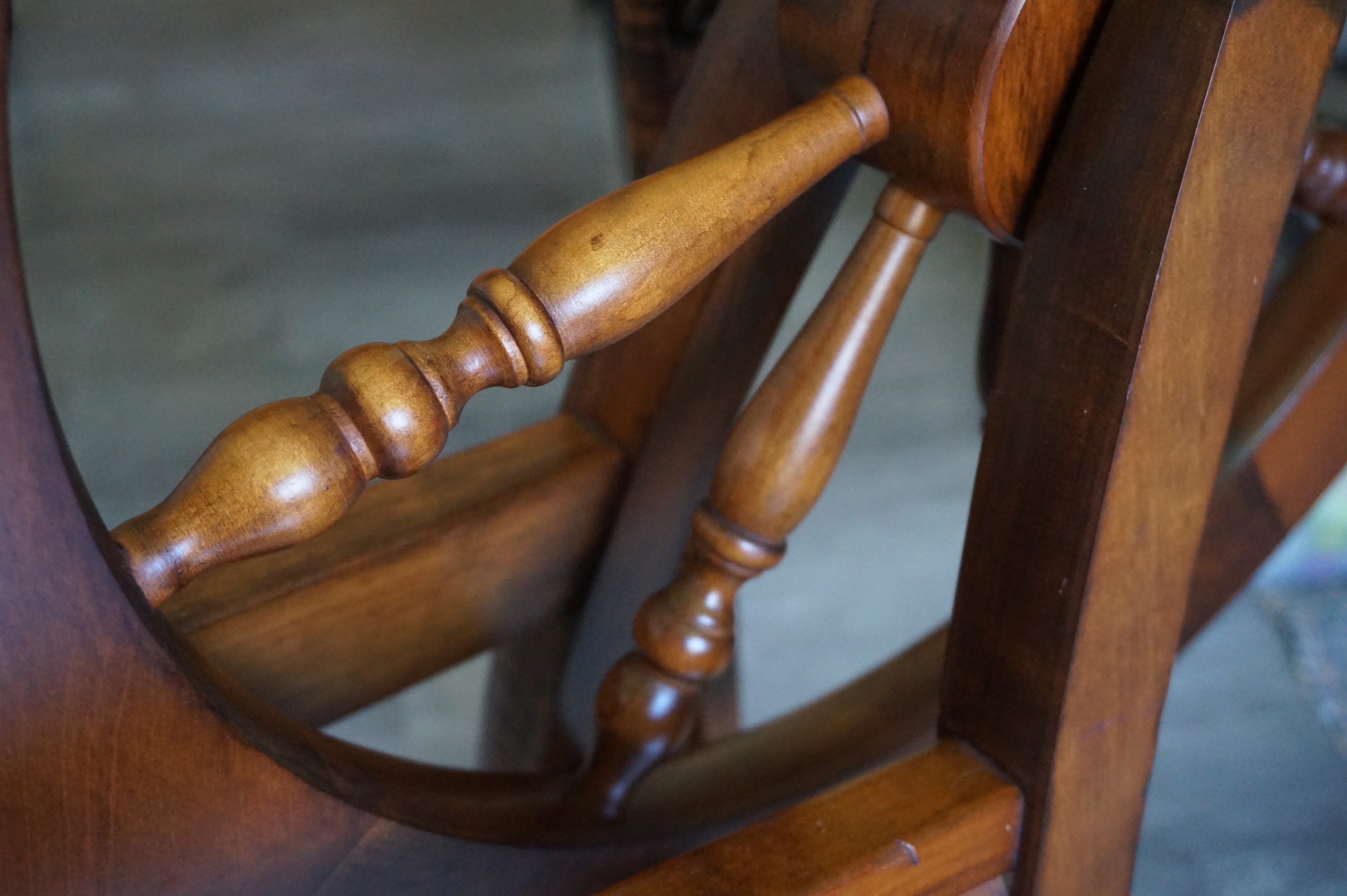
I was immediately enamoured with the decorative spokes and maid uprights, and the dark wood stain. Yes, we will address that carpet-covered treadle in a tad.
Thus, I sat down at the wheel, Deirdre handed me a flicked-open lock of fleece, and I quickly was able to do a lovely taffy-pull long draw. I then proceeded to dig through her stash of fleece to then find that 1.3kg bag of the Bond×Merino that I stuffed in the backseat of our hatchback at the feet of the wheel.
Behold, Sebastian the 1982 Ashford Traditional. Like his namesake, the crab in Little Mermaid, he enjoys a good whinge while doing an excellent job (read: he’s very creaky if I don’t oil every single joint before I give the drive wheel a push).

I managed to pry the carpet off the treadle using a flat-head screwdriver to lift and push the four edges up. Then, I sanded down the wood’s surface, and gave it a good polish with furniture wax. There are some small chips where the glue pulled the top layer of the wood off, but they’re very minor.
I am already spinning up my hand-combed polwarth/merino tops (intended for a jumper for my husband) on Sebastian, and the drive wheel just wants to keep going once it’s started. I can get a very sustained long draw with minimal adjustment of the brakeband, to spin a laceweight single.

The wheel-lust has completely been cured with the addition of Sebastian. Plus, we’re already at a 1:1 ratio of human:wheel in this household.
Naturally, I gave Sebastian a photoshoot this morning when the overcast lighting was just right. I reckon this wheel is going to be with me for a long long long while.


Bonus: Sebastian next to Pip. The size difference cracks me up.

Bonus bonus: Mr Louis and the new old wheel.


Leave a Reply